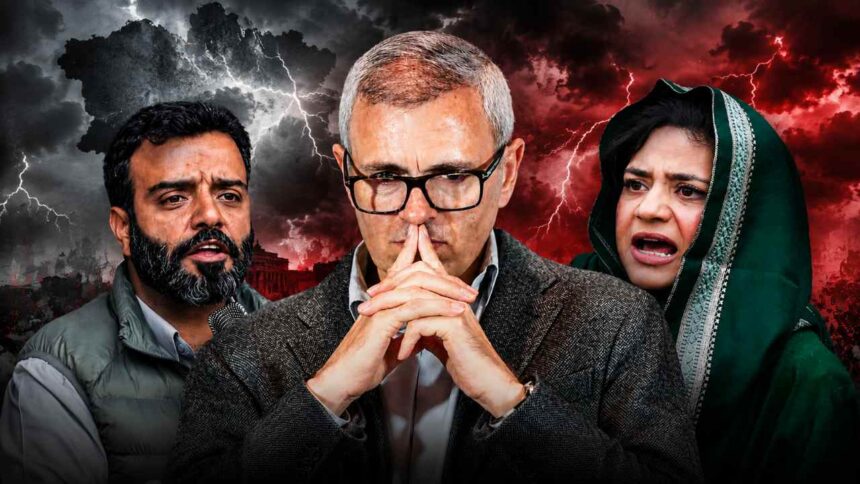
Srinagar, May 12: A fresh political controversy has erupted in Jammu and Kashmir after Chief Minister Omar Abdullah defended his government’s stance on liquor shops and alcohol regulation, triggering sharp reactions from opposition parties, political rivals, and even voices within the Valley’s larger political discourse.
What began as a public response to questions surrounding liquor sales quickly evolved into a wider debate on morality, religion, governance, addiction, election promises, and the changing social landscape of Jammu and Kashmir.
ALSO READ: Opinion | Why Are Public Spaces Treated as Temporary Zones in Kashmir?
At the centre of the storm are Omar Abdullah’s remarks in which he argued that the government was neither encouraging alcohol consumption nor forcing anyone to visit liquor shops.
“People are going to these shops on their own. We are not dragging anyone there, nor are we advertising alcohol,” Omar Abdullah said while speaking to media.
The Chief Minister’s remarks immediately triggered criticism across political circles, particularly in Kashmir, where alcohol remains a socially and religiously sensitive issue.
As criticism intensified, Omar Abdullah later clarified that his statement was being “twisted” and selectively interpreted by political opponents.
“Our religion does not permit alcohol, nor do we want people to move towards it,” he said. “But these shops exist for those whose religion permits alcohol consumption. No government in Jammu and Kashmir has imposed a ban on these shops so far.”
He emphasized that his administration had not opened any new liquor outlets and claimed that efforts were being made to ensure such shops were not located near areas where youth could be negatively influenced.
ALSO READ: PM Modi’s ‘Amrit Kaal’ Turning ‘Poison for Country’: Rahul Gandhi Slams NEET Paper Leak
“One thing is clear, we have not opened any new liquor shop,” he said. “Our effort has been that no such shop should exist in places where our youth may go astray.”
The Chief Minister also attempted to separate the issue of legal liquor sales from the growing narcotics crisis in Jammu and Kashmir, saying his government remained focused on anti-drug campaigns and action against substance abuse.
At the same time, Omar Abdullah accused opposition parties of politicizing the issue while ignoring their own record in government. Referring indirectly to the previous People’s Democratic Party (PDP)-led administration, he claimed that similar remarks regarding liquor regulation had earlier been made on the Assembly floor by the PDP’s finance minister.
“The same thing I said in Ganderbal had earlier been said in the Assembly by the PDP’s finance minister,” he remarked.
But the clarification did little to calm the political backlash.
PDP leader Iltija Mufti strongly criticized the National Conference government and questioned why Jammu and Kashmir could not consider prohibition laws similar to “dry states” such as Bihar and Gujarat.
ALSO READ: Over Two Lakh Outreach Programmes Held Across J&K Against Drug Menace: LG Sinha
“If governments in dry states like Bihar and Gujarat can ban alcohol, then why can’t a similar ban be implemented here?” she asked during a media interaction.
Iltija Mufti argued that no religion supports intoxicants and said Islam, Hinduism, Sikhism, and other faiths discourage alcohol and drug abuse.
She further accused the National Conference of abandoning promises made during election campaigns regarding regulation of liquor outlets and wine shops in the region.
The controversy escalated further after NC’s Srinagar MP Aga Syed Ruhullah Mehdi launched one of the sharpest attacks on Omar Abdullah’s remarks.
Calling the Chief Minister’s remarks “arrogant,” “unethical,” and “illogical,” Ruhullah said the National Conference had during campaigning promised stricter regulation of wine shops operating in local areas.
“If he remembers, we had clearly said during the campaign that these wine shops would be shut down and regulated,” Ruhullah said.
The Srinagar MP accused Omar Abdullah of failing to honour commitments made to the people and alleged that the Chief Minister’s remarks indirectly branded ordinary people as “drinkers” merely because liquor shops exist.
“The same Chief Minister whom the people of Kashmir and Jammu helped bring to power is now labeling his own people,” Ruhullah said.
He further alleged that the language used by Omar Abdullah resembled the rhetoric used against Kashmiris after 2019, when terms such as “corrupt,” “anti-national,” “terrorist,” and “drug addict” were repeatedly used in political narratives.
ALSO READ: Man Wanted in 17 Cases Arrested With Arms, Drugs in Jammu: Police
As opposition criticism intensified, senior National Conference leader and minister Sakina Itoo stepped in to defend the Chief Minister and accused the PDP of deliberately misleading people.
“The PDP has a habit of lying,” Sakina Itoo told reporters.
Defending Omar Abdullah, she said the National Conference had consistently opposed drug abuse and social harm caused by intoxicants.
“Omar Abdullah did not say anything wrong. He is the heartbeat of the people of Jammu and Kashmir,” she said. “Our party has always stood against drugs, against alcohol abuse, and against all harmful activities.”
Itoo also pointed out that leaders of the PDP themselves had earlier admitted in the Assembly that imposing a complete liquor ban was not practically feasible.
Meanwhile, National Conference chief spokesperson and Zadibal MLA Tanvir Sadiq also countered the criticism from PDP leaders.
“Those speaking about a liquor ban today are the same people whose Finance Minister had categorically stated in the Assembly that alcohol would not be banned,” Sadiq said.
He reiterated that the National Conference neither promotes alcohol consumption nor supports substance abuse in any form.
The debate soon expanded beyond the National Conference and PDP, drawing reactions from other political parties as well.
Senior BJP leader Ashok Koul said awareness and social responsibility were more effective solutions than blanket prohibition.
“We should stop drinking alcohol, taking drugs, and smoking cigarettes. Awareness needs to be created among people,” Koul said.
He argued that total prohibition often creates black markets for illegal liquor, leading to toxic alcohol consumption and loss of lives.
“In states where such laws exist, illegal and poisonous liquor starts circulating and people lose their lives,” he said.
Koul maintained that while governments can regulate alcohol sales, complete prohibition is often difficult to implement effectively.
What began as a brief public remark by the Chief Minister has now transformed into a wider debate about the identity and social direction of Jammu and Kashmir.
ALSO READ: Youth Injured in Narbal Road Accident Succumbs at SKIMS Soura
For many people in the Valley, the issue goes beyond liquor shops alone. It touches deeper anxieties surrounding rising drug addiction, changing social norms, unemployment among youth, and concerns about the erosion of traditional and religious values.
Political observers say the controversy also reflects the intense competition among regional parties to claim moral and political credibility on socially sensitive issues.
While the National Conference insists Omar Abdullah’s remarks were misrepresented for political gains, opposition parties continue to accuse the government of backtracking on election promises related to liquor regulation and public morality.
The exchange has dominated political discourse and social media discussions across Jammu and Kashmir, exposing deep divisions over how the region should balance personal freedom, religious sensitivities, public health concerns, and governance in an increasingly polarized political atmosphere.