It was a routine morning, and I was heading towards Srinagar on my two-wheeler when a small moment on the Rambagh Flyover stayed with me far longer than the journey itself.
Traffic was moving slowly. Beside me was a car carrying a man, perhaps in his forties. Sitting next to him was a young girl in school uniform — possibly his daughter. Her school bag rested quietly on her lap as she looked out through the window.
ALSO READ: Opinion | The Arrest of a Woman Peddler and the Rise of Online Cruelty
Then, without hesitation, the man rolled down his window and threw an empty plastic bottle onto the road.
The bottle bounced against the divider and rolled across the flyover before coming to a stop. The man drove away as if nothing had happened.



But something had happened.
A child had just watched an adult teach her that public roads are disposable. That somebody else will clean up after us. That once we step outside our homes, responsibility somehow ends.
And perhaps that is where Kashmir’s real civic crisis begins — not with garbage itself, but with the behaviour quietly passed from one generation to another.


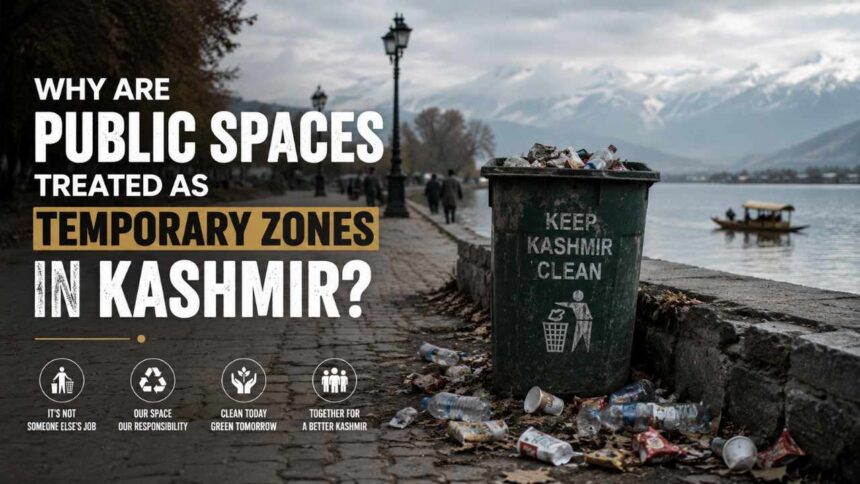
Every morning, Kashmir wakes up beautiful. But before the day fully unfolds, another picture begins to emerge — one that has become painfully ordinary.
A plastic bottle tossed from a moving car.
A chips wrapper drifting into a drain.
A tin can lying beside a park bench only a few feet away from a dustbin.
ALSO READ: Govt Strengthens Disease Surveillance as Hantavirus Cases Trigger Global Concern
Someone finishes tea and casually drops the disposable cup onto the roadside without even looking back. And nobody says anything.



That silence is perhaps the most disturbing part.
Because this is no longer an isolated act. It has become habit. A culture. A slow surrender of civic sense unfolding every single day across roads, parks, highways, markets, lakesides, and neighbourhoods.
Walk through the busy commercial centres of Srinagar, the quieter inner lanes of downtown, tourist spots, or even newly beautified public spaces — the evidence is everywhere. The city cleans itself every morning and litters itself again by noon.
The real problem is not just the waste. It is the indifference attached to it.
People across all age groups participate in this quiet destruction. A school student unwraps a snack and leaves the wrapper behind. An educated commuter throws a bottle from a car window. Families enjoying outings in parks leave food waste scattered behind. Tourists who arrive to admire Kashmir’s beauty often leave plastic and garbage at the very places they came to celebrate.
The question is simple, but deeply uncomfortable:
Why?
Why do we find it so difficult to carry waste a few extra steps to a dustbin? Why does public space feel like “nobody’s responsibility”? Why do roads, lakes, parks, and sidewalks become acceptable dumping grounds the moment we step outside our homes?
ALSO READ: Bandipora Tragedy: They Tried to Save Each Other, But Jhelum Took All Three
The irony is visible everywhere.
Dustbins have been installed across major roads, markets, and tourist destinations. Awareness boards exist.
Municipal workers clean streets tirelessly every single day.
Yet garbage continues to pile up because cleanliness cannot survive on infrastructure alone. It depends on conscience.
And conscience, perhaps, is what is slowly fading.
There are societies around the world where civic responsibility functions almost invisibly. People carry wrappers in their pockets until they find a bin. Travelers collect their own waste even in remote mountains where nobody is watching. Children are taught from an early age that public spaces deserve the same respect as private homes.
In some countries, strict fines reinforce discipline. But beyond laws, there exists something deeper — a collective understanding that cleanliness is not somebody else’s job. That understanding feels weak here.
In Kashmir, conversations about cleanliness often begin and end with criticism of authorities. Roads are dirty, drains are clogged, parks are neglected — and certainly, governance failures do exist.
But there is also a truth we struggle to confront: many of these places are dirtied not by systems, but by ordinary people making ordinary choices every day.
A person who would never throw garbage inside his own home casually litters a public road. Someone who carefully maintains cleanliness indoors thinks nothing of leaving waste behind after a picnic.
The contradiction exposes how disconnected we have become from the idea of shared responsibility.
Public spaces are treated as temporary zones where accountability disappears.
Perhaps part of the problem lies in upbringing. Civic etiquette is rarely taught strongly enough at home or in schools. Children learn mathematics, science, and grammar, but many never truly learn how to behave responsibly in shared environments.
ALSO READ: Teen Kills Close Friend With Cricket Bat Over ‘Love’ Rivalry in J-K
Instead, they watch adults spit on roads, throw wrappers from windows, damage public property, and normalize disorder.
Habits travel silently across generations.
There is also a dangerous culture of normalization. When litter is already everywhere, one more wrapper feels insignificant. People begin to think: “Everyone does it.”
And slowly, collective irresponsibility becomes socially acceptable.
Tourism adds another layer to the crisis.
Kashmir markets itself as paradise. Lakes, mountains, gardens, and meadows draw visitors from everywhere. Yet many tourists treat these landscapes like disposable picnic grounds.
Plastic bottles float in streams. Food packaging lies scattered across trekking routes. Tourist destinations once known for serenity now struggle under piles of non-biodegradable waste.
Ironically, people travel thousands of kilometres to experience nature while simultaneously contributing to its destruction.
Still, amidst the disappointment, there are moments that restore hope.
There are volunteers quietly cleaning riverbanks on weekends. Young people conducting awareness drives in schools. Shopkeepers placing dustbins outside their stores. Citizens who refuse to litter even when nobody is watching.
These people remind us of something important:
Civic sense is not about surveillance. It is about character.
Because the real test of responsibility is not what we do when cameras are present or fines are imposed. It is what we do when we are standing alone on an empty road holding a plastic bottle in our hand.
Do we throw it away carelessly?
Or do we carry it until we find a dustbin?