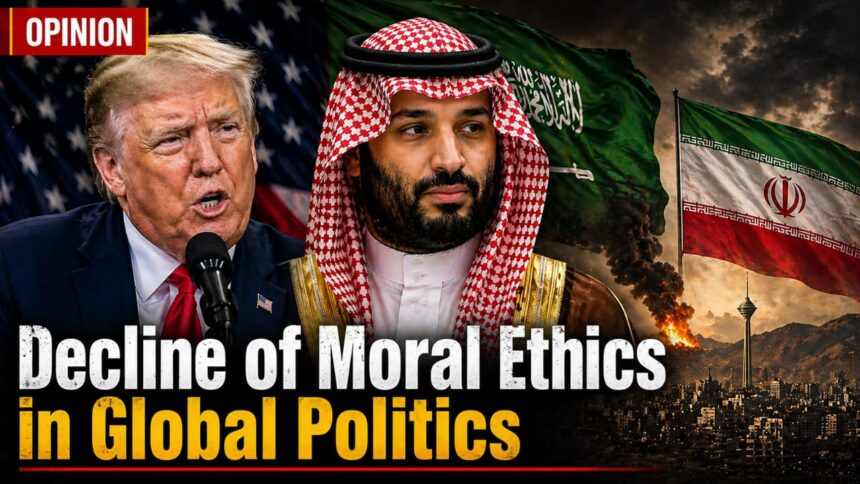
In the ongoing war “imposed” by the United States and Israel on the Islamic Republic of Iran, the world has witnessed widespread destruction, chaos, and loss of life, along with severe physical and material damage.
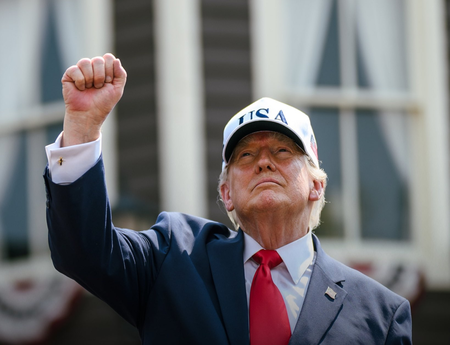
However, alongside these visible consequences, another equally significant development has emerged during this conflict: the decline of moral ethics in global politics. During the course of the war, U.S. President Donald Trump said that Saudi Arabia’s Crown Prince Mohammed bin Salman was effectively “kissing my ass” while working together in the ongoing Middle East war against Iran.
ALSO READ: Over 30 Million Enrol in Iran’s ‘Janfada’ Campaign
The use of such vocabulary by the head of a country—especially when referring to another leader who is also regarded as the custodian of the Two Holy Mosques of Islam—is deeply demeaning.
Regardless of whether one views the Saudi leadership as good or bad, the absence of a strong reaction reflects a broader erosion of diplomatic dignity. It signals a deeper crisis in the norms of respect that traditionally underpin international relations.


This rhetorical pattern is not limited to a single instance. Recently, Donald Trump also reposted a podcast by American commentator Michael Savage in which India, China, and other nations were described as “hell-holes.” In the same discussion, remarks were made suggesting that people from these countries travel to the United States merely to exploit birthright citizenship laws by having children there.
Such statements, widely criticised as racially insensitive and reductive, reflect a troubling tendency to generalise entire populations in a dismissive and derogatory manner. When amplified or endorsed by a sitting or former head of state, such rhetoric not only undermines diplomatic relations but also risks legitimising prejudice in global discourse. It represents a sharp departure from the language of mutual respect that is expected in international engagement.
Coming back to Saudi-U.S. relations, the fact remains that the closeness between Saudi Arabia and the United States has reached a point where Saudi Arabia finds it difficult to disengage, largely due to a lack of viable alternatives. Its security framework is heavily dependent on the United States—whether in terms of military equipment, technological advancement, or strategic protection. On the other hand, the Islamic Republic of Iran has endured some of the harshest sanctions for nearly 47 years.


Despite sustained pressure, it has focused on building its internal security capabilities, drawing strength not only from state institutions but also from its own population.
It is often argued that Iran’s model reflects a different kind of political culture—one in which leadership is portrayed as standing at the forefront during crises. This is contrasted with the perception in other countries where leaders are seen as prioritising their own survival.
Whether one agrees with this interpretation or not, such narratives have contributed to shaping a distinct discourse of resistance and political identity.
Returning to the central issue of moral decline, the lack of response from Saudi Arabia and several other Muslim-majority nations to such remarks is striking.
In the Muslim world, particularly in the subcontinent, Arab leadership—especially that of Saudi Arabia—is often viewed with a sense of reverence due to its association with Islam’s holy sites, but that perception is now changing.
Nevertheless, the use of such language by a sitting U.S. President marks a concerning departure from established diplomatic norms. It raises an important question: what kind of example does this set for global leadership? If the leader of a so-called superpower employs such rhetoric, it risks normalising a decline in standards across international politics.
The presidency of the United States has historically been associated with a certain level of decorum and responsibility in global affairs. Even in moments of disagreement or conflict, there has been an expectation that the office would uphold a minimum standard of respectful engagement. When that expectation is not met, it contributes to a broader erosion of trust and respect on the global stage.


This situation reflects a wider decline in moral standards within political discourse, one that is increasingly visible across the world. It underscores the need for leaders—regardless of their political positions or ideological differences—to maintain a commitment to ethical conduct and respectful communication.
ALSO READ: Tim Cook to step down as Apple CEO after nearly 15 years
Ultimately, this moment should serve as a lesson for current and future leaders alike. Political power carries with it not only authority but also responsibility—the responsibility to uphold dignity, foster mutual respect, and set a standard that strengthens, rather than undermines, the moral fabric of global politics.