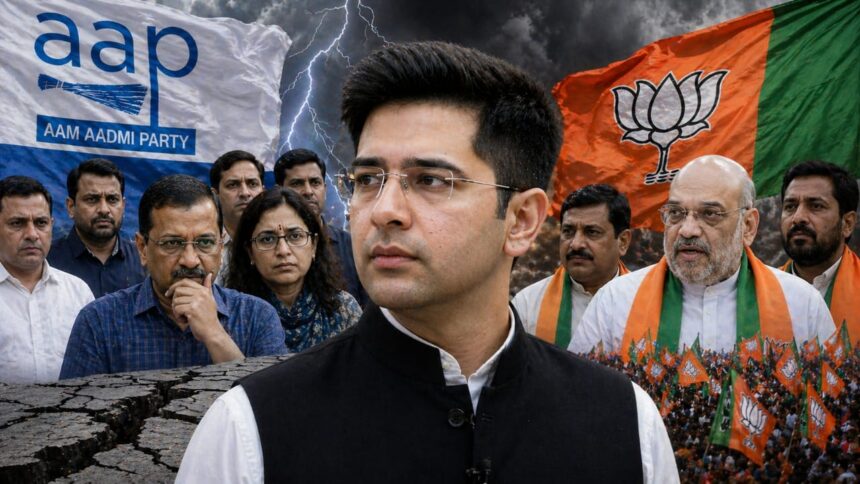
Srinagar, Apr 25: A political earthquake shook Indian politics when AAP MP Raghav Chadha dramatically switched sides, setting off a chain reaction that has rattled party structures, redrawn parliamentary equations, and ignited a fierce narrative battle across the country. The sudden political churn in Punjab is no routine reshuffle; it is a full-blown narrative war, playing out both inside Parliament and across social media. What began as internal dissent within the Aam Aadmi Party (AAP) has now escalated into a high-stakes political realignment, with the Bharatiya Janata Party (BJP) attempting to convert disruption into opportunity.
At the centre of this storm is Chadha, whose switch to the BJP on April 24 has triggered not just political shockwaves but also a viral backlash. His move came alongside six other AAP Rajya Sabha MPs—Sandeep Pathak, Ashok Mittal, Vikramjit Sahney, Rajinder Gupta, Harbhajan Singh, and Swati Maliwal—who collectively formed a two-thirds bloc and merged with the BJP, drastically altering the parliamentary arithmetic.
ALSO READ: Raghav Chadha, Harbhajan Singh Among 7 AAP Rajya Sabha MPs Set to Join BJP
This is not merely about numbers. Six of the seven defectors are from Punjab, leaving the AAP with just one Rajya Sabha MP from the state, Balbir Singh Seechewal.
The implications are immediate and severe, especially with Assembly elections less than a year away.

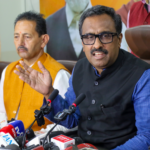

Punjab, where AAP once rode to a landslide victory in 2022 (winning 92 out of 117 seats), is now witnessing visible cracks within its leadership structure. Chadha, once seen as the architect of that victory, has now switched sides, declaring, “I didn’t want to be a part of their sins.” That statement alone reframes the political discourse from governance failures to a moral indictment of the party he once helped build.
While the BJP has gained six MPs overnight, its internal messaging reveals unease. Union Minister Ravneet Singh Bittu, himself a Congress-turned-BJP leader, had, just days before the defection, dismissed the need for Chadha to join the party, remarking that he was “already doing the work” against AAP.
Those remarks have since gone viral, particularly his controversial “catwalk” jibe and personal attacks, exposing a deeper contradiction: while the BJP is opening its doors to defectors, sections within the party appear uncertain about their long-term political integration.



This contradiction reflects a larger strategic gamble. The BJP, which currently holds just two MLAs in Punjab’s 117-member Assembly, is attempting to build a competitive structure from the ground up. Its vote share stood at around 19% in the 2024 Lok Sabha elections, yet it failed to secure a single seat. Now, through high-profile inductions, it is trying to fast-track political relevance. For AAP, however, this episode is more than a setback; it is a credibility crisis.
Punjab Chief Minister Bhagwant Mann has dismissed the defectors as non-mass leaders, even branding them “gaddar” (traitors). But the optics are difficult to contain. Graffiti targeting the rebel leaders with the same label has surfaced across parts of Punjab, transforming political dissent into a visible, street-level backlash. More concerning are the internal fault lines now coming into focus. Lok Sabha MP Malvinder Singh Kang pointed to a breakdown in communication within the party, revealing that Sandeep Pathak had not been contacted for nearly a year. If accurate, it suggests the rebellion was not sudden but the result of prolonged organisational disconnect.
The 2027 Assembly elections are shaping up to be a multi-cornered contest involving AAP, Congress, Shiromani Akali Dal, and the BJP. Union Home Minister Amit Shah has already declared that the BJP will contest the elections independently, effectively ending any prospect of reviving its alliance with the Akalis. For the BJP, leaders like Chadha represent more than numerical gains; they offer access to younger, urban voter bases. Party insiders believe Chadha’s strong social media presence could help bridge the party’s gap with Gen Z voters, a demographic where it has struggled to establish dominance. Yet, the situation remains layered and complex. The BJP has gained parliamentary strength but still lacks deep grassroots penetration in Punjab.
AAP retains state power but faces visible internal fractures. The defectors bring influence, but also controversy and questions about loyalty. Even figures like Ravneet Bittu, despite their prominence, face scepticism regarding their electoral pull within the state. What makes this episode particularly significant is its viral dimension. Political narratives are no longer shaped solely in legislative halls; they are built, contested, and amplified in real time across digital platforms. Bittu’s remarks, Chadha’s statements, and Mann’s counterattacks are all being consumed and dissected by a highly engaged audience. The battle, therefore, is not just for votes; it is for perception. In the short term, the BJP has gained undeniable momentum. In the long term, however, the real test lies in converting defections into durable voter support.
ALSO READ: “12th pass minister” remark backfires as Sakina Itoo responds
For AAP, the challenge is immediate and existential: rebuild trust, restore internal communication, and prevent further erosion of its leadership base. For Punjab, this marks the beginning of an intense political phase where alliances are fluid, narratives are volatile, and every move carries electoral consequences. The final verdict, however, will not emerge from Parliament or press conferences but from the people of Punjab when they head to the polls in 2027.