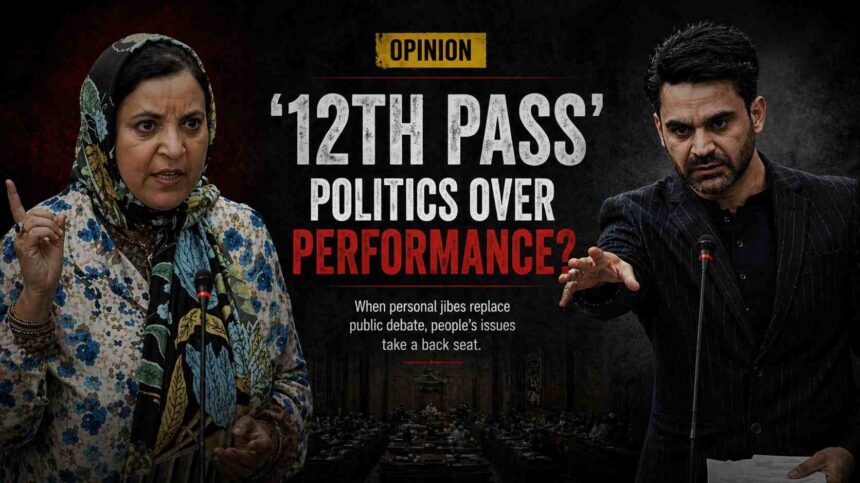
It takes very little these days to set off a political storm—sometimes just two words are enough. “12th pass.” Said once, repeated often, and amplified loudly, it quickly becomes the headline, the talking point, the debate. And just like that, politics shifts from purpose to pettiness.
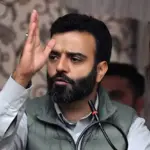
The recent “12th pass” jibe by Pulwama MLA Waheed Ur Rehman Para, aimed at Education Minister Sakina Masood Itoo, has once again exposed an uncomfortable reality: how easily our political discourse abandons substance and embraces ridicule. It was sharp, it was deliberate, and it did what such remarks are designed to do—grab attention. But beyond the noise, it leaves behind a more important question: is this what our politics has been reduced to?
ALSO READ: Opinion | Decline of Moral Ethics in Global Politics
Because if “12th pass” is now a political argument, then perhaps we have quietly accepted that governance is less about performance and more about perception.
Let’s be clear. In a democracy, legitimacy does not come stamped on a degree certificate. It comes from the people. It is the voters who decide who represents them, who speaks for them, and who governs on their behalf.
That mandate is not conditional on academic qualifications, nor does it require validation through public mockery.
The problem, therefore, is not that someone is “12th pass.”
The problem is that politics has reduced itself to counting certificates instead of delivering results.

There is something deeply ironic about this moment. At a time when people are grappling with real challenges—unemployment, access to quality education, healthcare gaps, and fragile infrastructure—the conversation is hijacked by a label. Not policies. Not reforms. Not outcomes. Just “12th pass.”
ALSO READ: J&K High Court Quashes PSA Detention of AAP MLA Mehraj Malik, Orders Release
It makes for easy politics. It avoids uncomfortable questions. And most importantly, it replaces accountability with amusement.
If “12th pass” is the new political insult, then perhaps governance itself has been replaced by grading. Leaders are no longer judged by what they do, but by how they are described. Debate is no longer about ideas, but about individuals.
And in that shift, something essential is lost.
Because when a representative is mocked for their educational background, it is not merely a personal attack. It carries a quieter, more troubling implication—that the choice made by the people is somehow inferior, that the mandate itself is flawed. That is not just unfair; it is deeply dismissive of the very foundation of democracy.
Democracy does not ask whether a representative is “12th pass” or a PhD.

It asks whether they can serve.
What follows such remarks is equally predictable. One comment invites another. A jibe triggers a rebuttal. Soon, what could have been a serious exchange turns into a cycle of personal attacks, with governance pushed further into the background. The louder the insults, the quieter the issues become.
And that is where politics begins to fail—not in disagreement, but in distraction.
Constructive criticism is not only valid; it is necessary. Policies must be questioned, decisions must be challenged, and those in power must be held accountable. But there is a clear line between critique and contempt. The former strengthens democracy. The latter reduces it to spectacle.
Today, it is “12th pass.” Tomorrow, it could be something else. The pattern remains the same: attack the person, avoid the problem.
Kashmir, however, does not have the luxury of such shallow politics. It demands seriousness. It demands empathy. It demands leadership that understands public office is not a platform for one-liners but a responsibility that affects real lives.
ALSO READ: Three school girls injured in Qazigund accident, driver arrested
People are not interested in political point-scoring. They are not concerned with who said what in a moment of rhetorical flourish. They are concerned with whether their children have access to better schools, whether hospitals function, whether roads improve, whether opportunities expand.
In a time of such pressing needs, reducing leadership to “12th pass” is not just shallow—it is evasive.
If politics continues down this path, it risks becoming louder, harsher, and increasingly disconnected from the realities it is meant to address. The way forward lies not in sharper insults, but in deeper engagement. Not in questioning personal backgrounds, but in improving public outcomes.
Because at the end of the day, every representative—regardless of their educational qualifications—sits in office because the people placed them there.
That trust deserves better than a label.