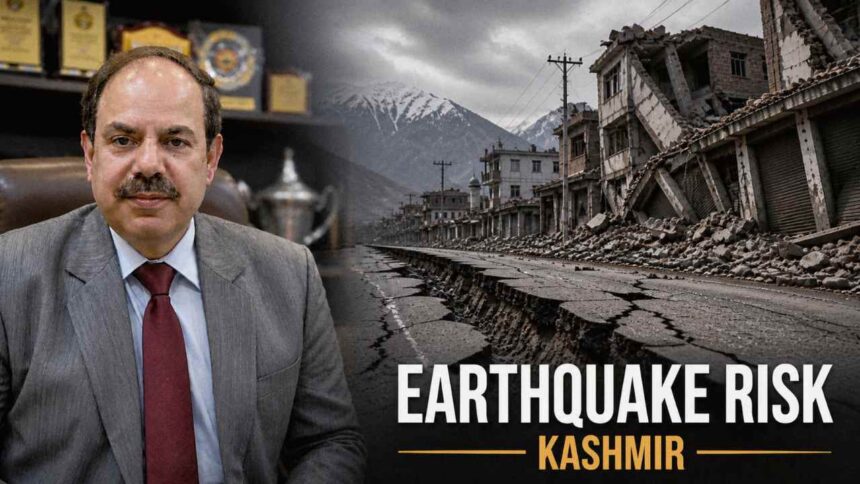
Srinagar, May 3: Kashmir remains dangerously unprepared for a major earthquake, and religious leaders must play a proactive role in raising awareness, a leading earth scientist has warned.
Speaking exclusively with Asian News Hub, Shakil Ahmad Romshoo, Vice Chancellor of the Islamic University of Science and Technology, said the Valley is “one major tremor away from large-scale devastation,” urging imams to use mosques and community platforms to educate people at the grassroots.
ALSO READ: Expert Flags Earthquake Risk, Says Most Srinagar Homes Not Resilient
“Jammu and Kashmir and Ladakh are highly vulnerable. Earthquakes are not new here—they are part of our geological reality,” Romshoo said, pointing to the fragile Himalayan terrain that has historically witnessed destructive seismic activity.
A Region Expanding, But Not Preparing


Even as urban expansion continues rapidly, safety measures remain largely absent.
“In Srinagar alone, there are about 2.5 lakh houses. Nearly 99 percent are unsafe in terms of earthquake resilience,” he warned.
The figure, he said, reflects a silent but growing crisis driven by widespread disregard for building norms.


“Just 10 percent additional cost in construction can make buildings earthquake-resistant. But we ignore that—and compromise our own safety,” he added.
History’s Warning—and a Bigger Threat Ahead
Romshoo pointed to Kashmir’s seismic history as a stark reminder of the looming danger.
He recalled a devastating earthquake in 1550, believed to be above magnitude 8, which killed over 3,000 people—when structures were far less dense and heavy.
“If such a quake strikes today, the damage would be unimaginable,” he cautioned.
He also referred to the 2005 Muzaffarabad earthquake, which measured 7.6 in magnitude and killed around 82,000 people across the region.



“And we must understand—Kashmir is capable of experiencing earthquakes of magnitude 8,” he said.
Preparedness Remains Critically Low
Despite repeated warnings, the Valley remains ill-prepared for a disaster of such magnitude.
“As a society, as a government, as a community—we must ask: if an earthquake strikes, what do we do? Right now, we are not ready,” Romshoo said.
He stressed that awareness must extend beyond official frameworks into everyday life, with communities equipped to respond effectively.
“Every household should know how to respond—how to evacuate, how to protect children and the elderly. Awareness can save lives,” he said.
As part of outreach efforts, the university has been conducting workshops and engaging with religious leaders, urging them to use platforms like mosques to spread life-saving information.
A Silent Threat Beneath Our Feet
Unlike other disasters, earthquakes strike without warning, and science still cannot predict their occurrence.
“There is no method to say when or where an earthquake will occur. But even a magnitude 7 quake can cause massive destruction,” Romshoo said.
ALSO READ: Kidney Failure, Bladder Cancer Cases Rising in Kashmir: Top Urologist Warns
He emphasised that the real challenge lies not just in awareness but in action.
“This is not a choice anymore—it is a necessity. The question is not if an earthquake will strike, but whether we will be ready when it does.”