Srinagar, May 1: Kashmir may appear calm on the surface, but experts say the region is sitting on a serious seismic risk that cannot be ignored.
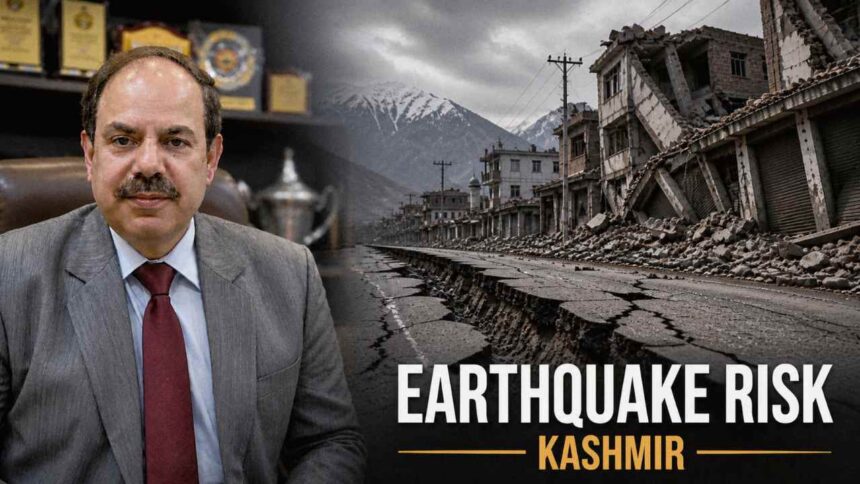
A leading earth scientist and Vice Chancellor of Islamic University of Science and Technology, Shakil Ahmad Romshoo, while speaking to Asian News Hub, warned that nearly 99 per cent of residential houses in Srinagar are not earthquake-resistant, making the city highly vulnerable in the event of a major tremor.
ALSO READ: ‘Zuv Wondmaya, Chaaney Khatre Aas’: A Son’s Emotional Reunion with His Ailing Father
“Kashmir is not just earthquake-prone—it is one major quake away from large-scale devastation,” Romshoo said, pointing to the fragile Himalayan terrain that has historically witnessed powerful seismic activity.
Rapid Growth, Weak Safety



With construction booming across Srinagar and other parts of the Valley, experts say safety standards have not kept pace.
“In Srinagar alone, there are around 2.5 lakh houses. Nearly 99 per cent are unsafe in terms of earthquake resilience,” he said.
What makes the situation more worrying, he added, is that the risk is largely preventable.


“Just about 10 per cent additional cost during construction can make buildings earthquake-resistant. But we often ignore this and compromise safety,” he said, highlighting widespread violations of building norms.
Lessons from the Past
Kashmir’s history carries clear warnings. Romshoo referred to a massive earthquake in 1550, believed to be above magnitude 8, which killed thousands at a time when buildings were simpler and less dense.
“If such a quake strikes today, the damage would be unimaginable,” he cautioned.
He also pointed to the 2005 Muzaffarabad earthquake, which measured 7.6 in magnitude and left around 82,000 people dead across the region.
“Kashmir is capable of experiencing earthquakes of magnitude 8,” he added.



Lack of Preparedness
Despite the known risks, preparedness remains low.
“As a society, as a government, as a community—we must ask ourselves: if an earthquake strikes, what do we do? At present, we are not ready,” he said.
He stressed that awareness needs to reach every household.
“People must know how to respond, how to evacuate safely, and how to protect children and the elderly. Awareness can save lives,” he said.
A Silent Threat
Unlike floods or storms, earthquakes strike without warning, and there is still no reliable way to predict when or where they will occur.
“Even a magnitude 7 earthquake can cause massive destruction,” Romshoo said.
To address the gap, the Islamic University of Science and Technology has been conducting outreach programmes, including workshops and community awareness sessions.
However, he stressed that awareness alone is not enough. “This is no longer a choice—it is a necessity. The real question is not if an earthquake will strike, but whether we will be ready when it does.”
A Warning That Cannot Be Ignored
As Kashmir continues to expand and build upward, experts say the real danger lies in ignoring scientific warnings.
ALSO READ: Drug De-Addiction Awareness Programme Held at PHC Pahroo in Budgam Under Nasha Mukt Abhiyan
Because when the ground shakes, it will not just test buildings—it will test how prepared society truly is.