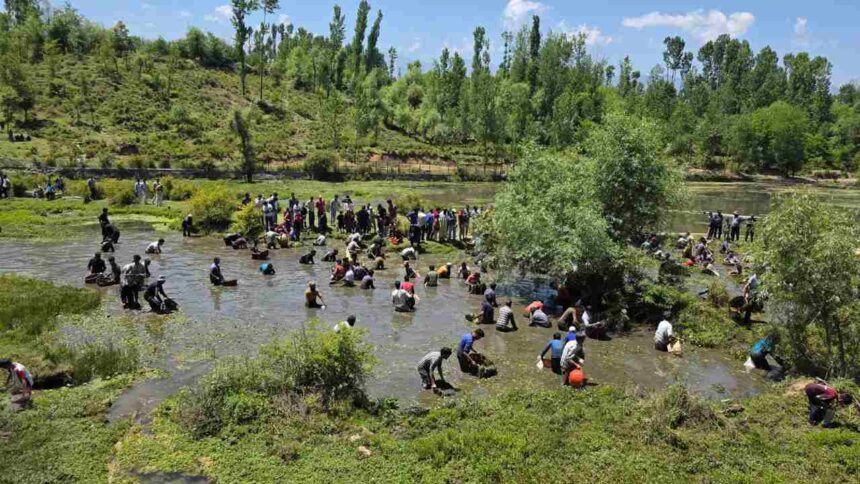
Srinagar, May 17: Every year in the quiet village of Panzath in South Kashmir’s Kulgam district, hundreds of people step into cold waters carrying baskets, nets, and hopes of catching fish. But beneath the excitement, celebration, and chaos lies a far deeper purpose protecting and reviving a water body that has sustained generations.
ALSO READ: Release Prisoners Ahead of Eid as First Confidence-Building Measure: Mehbooba Mufti
Locals say the annual festival is not merely about fishing. It is a centuries-old community-driven tradition aimed at cleaning the streams and springs connected to the famous Panzath water body, considered one of Kashmir’s richest freshwater sources.
Residents claim that more than 500 natural springs are linked to the Panzath stream system, making it one of the most water-abundant regions in the Valley.
“People come believing they might catch fish, but the real purpose of the festival is to clean the water body,” said a local resident associated with the event. “When hundreds of people enter the stream together, the weeds, mud, waste, and accumulated dirt get cleared naturally.”



According to locals, the tradition has continued uninterrupted for generations. While many villagers believe the practice is more than 200 years old, others say it may date back nearly 500 years.
“This is not a new festival. Our elders celebrated it, and their elders before them,” another resident said. “It has survived because people here understand the importance of protecting water.”
Every year, people from over 100 nearby villages reportedly participate in the event. Villagers enter the stream in large numbers, attempting to catch fish by hand or through traditional methods. While only a few succeed in catching fish, locals say the real success of the festival lies elsewhere — in restoring the water body itself.


The collective activity helps remove weeds, waste material, mud deposits, and stagnant pollution that gradually accumulate in the stream over time.
In recent years, concerns over pollution in Kashmir’s water bodies have increased sharply. Environmentalists and residents alike have repeatedly warned that untreated waste, garbage dumping, and human negligence are damaging rivers, lakes, and freshwater springs across the Valley.
Locals in Panzath say their festival stands as a powerful example of collective responsibility at a time when many water bodies in Kashmir continue to deteriorate.
“Today, people throw waste into streams and rivers without thinking about the consequences,” a local said. “Pollution has become one of the biggest threats to our water sources. This festival reminds people that protecting water is everyone’s responsibility.”
Residents describe the gathering as one of the Valley’s strongest examples of unity, environmental awareness, and community participation. Villagers from different areas come together not only for celebration, but also to preserve a resource deeply connected to their lives and livelihoods.
According to locals, another traditional event known as “Rohun Posh” is observed later in the evening, after 4 pm, adding further cultural significance to the occasion.



The festival also highlights how traditional Kashmiri practices often carried environmental wisdom long before modern conservation campaigns emerged.
“In today’s time, governments and organisations spend crores on awareness campaigns,” said a resident. “But our ancestors had already created a system where society itself participated in protecting nature.”
As Kashmir faces growing environmental stress, declining water quality, and rising pollution in rivers and lakes, many residents believe traditions like the Panzath festival offer an important lesson: conservation is far more effective when entire communities participate.
For the people of Panzath, the annual gathering is not simply about fish.
ALSO READ: Iran Prepares a ‘Professional Mechanism’ to Manage Hormuz Traffic
It is about preserving water, protecting heritage, and reminding future generations that nature survives only when communities choose to protect it.