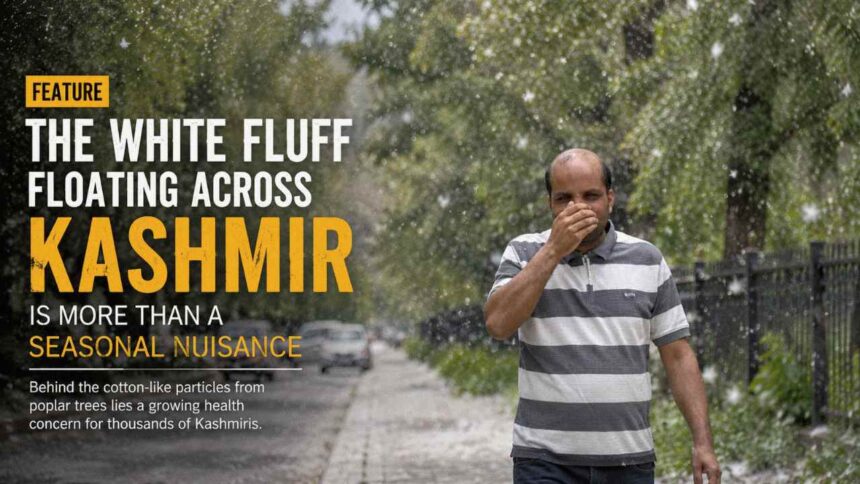
Every year, as spring settles across Kashmir, the Valley begins to resemble a strange winter dream. White flakes drift slowly through the air like soft snowfall. Roadsides, parks, rooftops, hospital windows and school grounds appear covered in cotton.
From a distance, it looks beautiful.
But for thousands of Kashmiris, that floating white fluff has quietly become a growing health concern entering homes, lungs, kitchens, hospitals and everyday life.
Across South, North and Central Kashmir, residents are once again struggling with the cotton-like particles released by female varieties of Australian poplar trees, commonly known locally as Russian poplars. This year, many residents say the situation feels worse than before.
ALSO READ: Feature | Why Omar Abdullah’s Alcohol Remarks Sparked a Political Storm in J&K



“You cannot escape it,” said a resident from Srinagar while cleaning fluff gathered near his window. “Even if you close the doors, it still enters the rooms. It settles everywhere — on beds, food, clothes and medicines.”
Outside, the particles continue floating endlessly through neighbourhoods. Inside homes, they gather silently in corners like unwanted dust. For families with elderly patients, asthma sufferers or young children, this season has become deeply uncomfortable.
Parents say children are coughing more frequently and complaining of throat irritation and breathing discomfort while walking to school or playing outdoors. Some families have even started using masks again — not because of pollution from traffic, but because of trees planted years ago.



“The fluff enters the nose and throat even through masks,” said a worried parent. “Even hospitals are not safe from it.”
The trees behind the issue are not new to Kashmir. For years, poplar trees were planted widely across the Valley because they grow rapidly and carry commercial value.
However, environmental experts and forestry officials say there are male and female varieties of these trees, and it is the female trees that release the cotton-like fluff during spring.
Over the years, authorities attempted to control the issue. The Social Forestry Department earlier distributed male saplings during plantation drives, while campaigns were launched in several districts to identify and remove female poplar trees after repeated public complaints.
ALSO READ: ‘Even ₹10 Baby Diapers Don’t Leak, But NEET Papers Do’: Khan Sir Slams NTA
For a while, residents say, there was some relief.



But now, the fluff is back — thicker, heavier and more widespread.
Many residents believe that despite awareness campaigns, female trees continued to be planted in several areas, allowing the problem to grow further with time.
The impact extends beyond breathing discomfort.
The airborne fluff settles on vegetables in markets, enters kitchens and cooking spaces, sticks to food during family gatherings and raises hygiene concerns inside homes. Shopkeepers repeatedly sweep their storefronts, only to find them covered again within minutes.
“It feels like the entire air is filled with cotton,” said an elderly resident. “We clean our park, and it fills up again immediately.”
For elderly people already battling illness, the season brings exhaustion and invisible discomfort drifting through windows and hospital corridors.
Environmental experts have long warned that uncontrolled plantation of female poplar trees can worsen seasonal allergies and air irritation, especially during peak shedding periods. Residents now believe the issue should no longer be treated as a minor inconvenience.
Across districts, people are urging the administration, Deputy Commissioners and concerned departments to take immediate measures by identifying, pruning or removing female poplar trees and ensuring that only male varieties are promoted during future plantation drives.
ALSO READ: Opinion | Beyond Revenue: The Moral Cost of Liquor in Kashmir
Many residents believe the issue deserves the same seriousness as other public awareness campaigns run by the government.
Because for Kashmiris, this is no longer just white fluff floating in the air — it is quietly turning an entire season into a struggle to breathe.
From far away, the Valley may still look beautiful beneath those drifting white particles.
But up close, many people here are simply trying to live through them.