A wedding is meant to be one of the happiest and most memorable moments in a person’s life. It is a celebration of love, family, culture and togetherness. But a recent viral video from a remote area of Kashmir has sparked an uncomfortable conversation across social media — not about joy, but about the growing culture of humiliation disguised as entertainment.
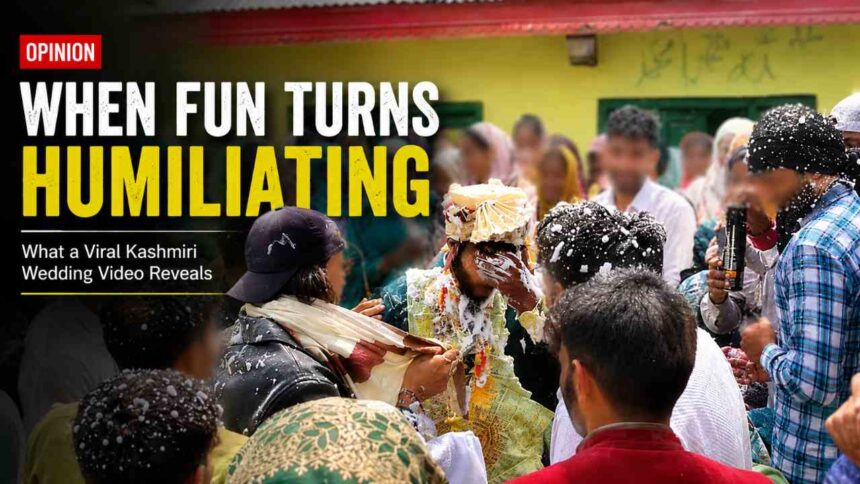
The video, widely circulated online over the past few days, shows a bridegroom surrounded by a crowd during his wedding celebrations. As laughter and cheers fill the atmosphere, people begin showering him with excessive amounts of snow spray. At first glance, the scene may appear festive and humorous to some viewers. But a closer look tells a different story.
ALSO READ: Feature | The White Fluff Floating Across Kashmir Is More Than a Seasonal Nuisance
The groom can be seen repeatedly trying to protect himself and stop those around him. He appears visibly uncomfortable and helpless. Yet the people surrounding him continue laughing, recording videos and carrying on with the spectacle, seemingly unaware of — or unconcerned about — his distress.
The incident has triggered mixed reactions online. While some users treated the moment as harmless fun, many others expressed concern, calling the behaviour disrespectful, insensitive and culturally disturbing.



The problem is no longer limited to one wedding video alone. It reflects a growing social pattern where public humiliation is increasingly being normalised in the name of entertainment, trends and social media attention.
In Kashmir, weddings have traditionally been associated with dignity, warmth, modesty and cultural grace.
Celebrations were centred around family values, hospitality and emotional connection. There was joy, laughter and festivity — but also a strong sense of respect for personal boundaries and social conduct.



ALSO READ: Opinion | Decline of Moral Ethics in Global Politics
Today, however, the influence of social media is rapidly reshaping public behaviour.
Viral culture has created a strange pressure to make every event “content-worthy.” In that race for views, likes and online attention, many people no longer stop to ask an important question: Is the person involved actually comfortable?
That question becomes especially important in videos like this one.
The groom in the viral clip was not laughing freely or participating willingly. He was trying to stop the act. Yet the crowd around him continued, perhaps believing it was all part of the celebration. This reflects a dangerous social tendency where a person’s discomfort is ignored simply because others are enjoying the moment.
Such incidents are becoming increasingly common.



At weddings and social gatherings, people are often forced into embarrassing situations for the amusement of others. Faces are shoved into cakes, individuals are sprayed with chemicals or colours, dangerous stunts are performed, and private moments are turned into viral clips without consent.
What many dismiss as “fun” can sometimes leave lasting emotional humiliation.
There is also a physical safety aspect that cannot be ignored. Excessive use of artificial snow spray in crowded spaces can affect breathing, irritate the eyes and cause discomfort, especially when sprayed directly onto someone’s face repeatedly. In enclosed spaces, chemical sprays can even become hazardous.
ALSO READ: Pak-Sponsored Terrorism, Narco Trade Biggest Threats, Will Hunt Down Drug Syndicates: J&K DGP
But beyond health concerns lies a deeper social question: Why are people becoming comfortable watching someone struggle in the middle of a celebration?
Part of the answer lies in the changing psychology of social media culture.
Today, every gathering has become a performance. Phones are constantly recording. Moments are no longer experienced naturally; they are staged for online audiences. The desire to create viral content often overpowers empathy, sensitivity and basic human decency.
In many cases, people no longer react as participants in a social event — they react as content creators searching for entertainment.
The viral wedding clip from Kashmir also highlights another important reality: the slow erosion of cultural values under the influence of performative internet culture.
Kashmir’s social traditions have historically valued respect, modesty and emotional sensitivity. Publicly humiliating someone during an important life event would once have been considered inappropriate and shameful.
But today, behaviour that would earlier have been questioned is often defended as “just for fun.”
This normalisation is worrying.
Because when humiliation becomes entertainment, society slowly loses its ability to recognise emotional harm.
The issue is not about opposing celebration, laughter or modernity. Happiness should absolutely be shared and enjoyed. But there is a difference between joyful celebration and forcing someone into discomfort for public amusement.