

By University of Arizona

Researchers at the University of Arizona are developing a COVID-19 testing method that uses a smartphone microscope to analyze saliva samples and deliver results in about 10 minutes.
The UArizona research team, led by biomedical engineering professor Jeong-Yeol Yoon, aims to combine the speed of existing nasal swab antigen tests with the high accuracy of nasal swab PCR, or polymerase chain reaction, tests. The researchers are adapting an inexpensive method that they originally created to detect norovirus—the microbe famous for spreading on cruise ships—using a smartphone microscope.
They plan to use the method in conjunction with a saline swish-gargle test developed by Michael Worobey, head of the UArizona Department of Ecology and Evolutionary Biology and associate director of the University of Arizona BIO5 Institute.
The team’s latest research using water samples—done in collaboration with Kelly A. Reynolds, chair of the Department of Community, Environment and Policy in the UArizona Mel and Enid Zuckerman College of Public Health—is published today in Nature Protocols.
“We’ve outlined it so that other scientists can basically repeat what we did and create a norovirus-detecting device,” said Lane Breshears, a biomedical engineering doctoral student in Yoon’s lab. “Our goal is that if you want to adapt it for something else, like we’ve adapted it for COVID-19, that you have all the ingredients you need to basically make your own device.”
Yoon—a BIO5 Institute member who is also a professor of biosystems engineering, animal and comparative biomedical sciences, and chemistry and biochemistry—is working with a large group of undergraduate and graduate students to develop the smartphone-based COVID-19 detection method.
“I have a couple of friends who had COVID-19 that were super frustrated, because their PCR results were taking six or seven days or they were getting false negatives from rapid antigen tests. But when they got the final PCR tests, they found out they had been sick, like they’d suspected,” said Katie Sosnowski, a biomedical engineering doctoral student who works in Yoon’s lab. “It’s really cool to be working on a detection platform that can get fast results that are also accurate.”
Cheaper, Simpler Detection
Traditional methods for detection of norovirus or other pathogens are often expensive, involve a large suite of laboratory equipment or require scientific expertise.
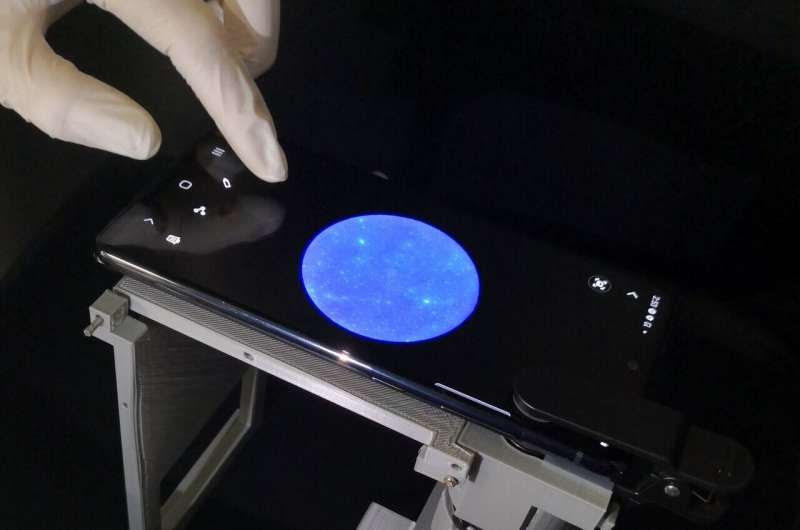
The smartphone-based norovirus test developed at UArizona consists of a smartphone, a simple microscope and a piece of microfluidic paper—a wax-coated paper that guides the liquid sample to flow through specific channels. It is smaller and cheaper than other tests, with the components costing about $45.
The basis of the technology, described in a 2019 paper published in the journal ACS Omega, is relatively simple. Users introduce antibodies with fluorescent beads to a potentially contaminated water sample. If enough particles of the pathogen are present in the sample, several antibodies attach to each pathogen particle.
Under a microscope, the pathogen particles show up as little clumps of fluorescent beads, which the user can then count. The process—adding beads to the sample, soaking a piece of paper in the sample, then taking a smartphone photograph of it under a microscope and counting the beads—takes about 10 to 15 minutes. It’s so simple that Yoon says a nonscientist could learn how to do it by watching a brief video.
The version of the technology described in the Nature Protocols paper makes further improvements, such as creating a 3-D-printed housing for the microscope attachment and microfluidic paper chip. The paper also introduces a method called adaptive thresholding. Previously, researchers set a fixed value for what quantity of pathogen constituted a danger, which limited precision levels.
The new version uses artificial intelligence to set the danger threshold and account for environmental differences, such as the type of smartphone and the quality of the paper.