For generations, pursuing an MBBS degree has been synonymous with prestige, stability, and societal respect. It has long been considered a “safe” career choice, particularly in countries like India, where medicine is held in high regard. However, the reality for today’s medical aspirants is far more complex. With evolving regulations, increasing financial burdens, and uncertain career prospects, especially under the recent National Medical Commission (NMC) guidelines, the MBBS pathway is no longer the universally attractive option it once was.
One of the earliest and most decisive challenges arises even before a student enters medical school: affordability, compounded by systemic barriers to accessing government seats. Government medical colleges offer limited seats, and while the reservation system was introduced with the intent of promoting social equity, its current implementation is often viewed by many as flawed and illogical. A significant proportion of seats are reserved under multiple categories, which, in practice, makes securing admission through the open merit route extremely difficult, even for highly scoring candidates. In extreme cases often cited in public discourse, candidates with very low or even single-digit scores have secured postgraduate seats in competitive specialties at top institutions, highlighting the perceived imbalance in the system.
As a result, a large number of students are left with the option of private institutions, where the cost of studying MBBS is prohibitively high. This stark financial barrier pushes many middle-class families to consider alternatives abroad. Unlike private engineering colleges, where fees are relatively manageable, private medical education in India is simply out of reach for most, often starting at around one crore rupees.
This financial constraint, combined with limited access through the open merit route, becomes the primary reason why thousands of Indian students opt to pursue MBBS degrees abroad. Countries offering comparatively lower tuition fees and easier admission processes become attractive destinations, though this decision comes with its own set of challenges, many of which are underestimated at the time of choosing this path.
MBBS, regardless of location, is an inherently demanding course. It is often regarded as one of the toughest degrees in the world, requiring immense dedication, discipline, and resilience. The five to six years of study involve mastering vast subjects, undergoing rigorous clinical training, and dealing with high levels of stress. For students studying abroad, these challenges are compounded by language barriers and cultural differences.


The real difficulties, however, begin after graduation. Foreign Medical Graduates (FMGs) must clear a licensing examination to practise in India. Earlier conducted as the FMGE screening test under the Medical Council of India (MCI), this process is now overseen by the NMC. Over time, the nature and difficulty level of this examination have changed significantly. What was once considered a screening test has evolved into an extremely difficult licensing examination. Experts have pointed out that the question bank overlaps almost entirely with that of NEET-PG, making preparation even more demanding. Adding to this concern is the consistently low pass rate. In some examination sessions, the pass percentage has fallen to around 10%, while on average, it remains between 15% and 25%, reflecting the examination’s high level of difficulty.
Beyond the examination itself, FMGs face systemic challenges that extend into their professional lives. Despite having completed the same medical degree and successfully clearing the FMGE, they are often viewed as less competent than their counterparts trained in India. However, the National Medical Commission (NMC) grants them a licence to practise only after they have successfully cleared the FMGE and satisfied all its prescribed licensing requirements, making this persistent stigma difficult to justify.
The process of reintegration into the Indian medical system is also lengthy and frustrating. After clearing the licensing examination, FMGs often have to wait for months, sometimes as long as six to nine months, to obtain state medical council registration. Only then can they begin their mandatory internship in India. Even at this stage, many FMGs face inequities. In several states, they are either underpaid or not paid at all during their internship, unlike Indian Medical Graduates (IMGs), who receive stipends as part of their training.



Adding to this burden is the rule mandating an additional year of internship in India for students who began their MBBS abroad after 18 November 2021. This effectively extends the duration of their medical education to nearly seven years. For students who have already endured financial strain, academic pressure, and regulatory hurdles, this additional requirement appears excessive and discouraging.
Even after overcoming all these obstacles, the challenges do not end. The job market for MBBS graduates in India has become increasingly saturated. Unlike a decade ago, when an MBBS degree itself could secure a stable job, today’s scenario is markedly different. The growing number of graduates has led to intense competition for limited opportunities. As a result, many young doctors are forced to accept jobs with salaries as low as ₹40,000 per month.
This situation is not a reflection of their competence or dedication but rather a consequence of systemic imbalance. The supply of doctors has increased significantly, while the availability of well-paying, structured jobs has not kept pace. For many, the only viable path forward is postgraduate specialization, which introduces yet another cycle of demanding examinations, uncertainty, and delayed financial stability.
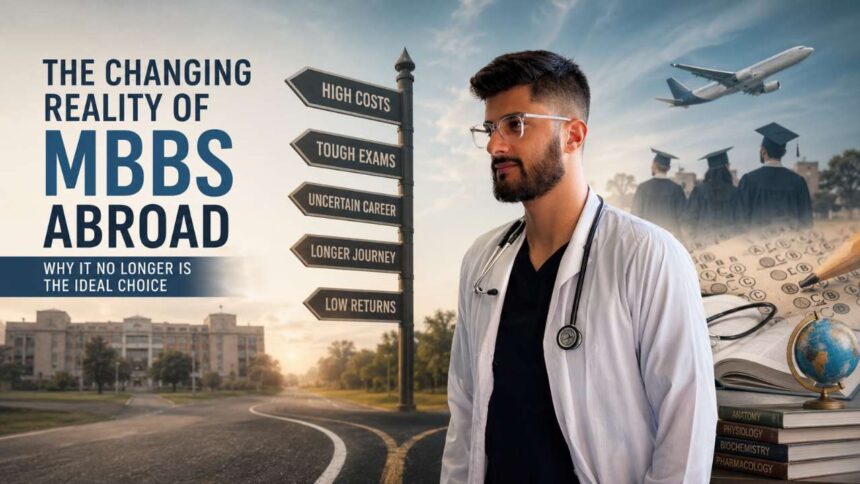
When viewed collectively, these factors raise serious questions about the viability of MBBS as a career choice, particularly for those considering studying abroad. The combination of high financial investment, prolonged training duration, regulatory uncertainty, and limited immediate returns makes it a challenging and, in many cases, risky decision.
This is not to diminish the value or importance of the medical profession. Doctors remain the backbone of any healthcare system, and the sense of purpose associated with saving lives is unparalleled. However, it is crucial to move beyond outdated perceptions and present a realistic picture to aspiring students and their families.
Choosing MBBS today requires more than just academic capability; it demands informed decision-making, financial planning, and a clear understanding of long-term commitments. Students must weigh their options carefully, considering not only their passion for medicine but also the practical challenges that lie ahead.


In conclusion, while MBBS continues to be a noble and respected profession, it is no longer the straightforward path to success it once appeared to be. The evolving regulatory framework, especially under the NMC, coupled with financial and professional uncertainties, has transformed the landscape of medical education. For many students, particularly those considering studying abroad, it may no longer be the most practical or rewarding choice. Thoughtful evaluation and awareness are now more important than ever before committing to this demanding and increasingly uncertain career path.
Disclaimer: The views and opinions expressed in this article are solely those of the author, Dr. Mohammad Sarhan (MBBS, FMG), and do not necessarily reflect the views, editorial policy, or position of Asian News Hub. This article is published in the Opinion section to encourage informed discussion on issues of public interest.
Author:
Dr. Mohammad Sarhan
MBBS (FMG)
muhmmadsarhan117@gmail.com