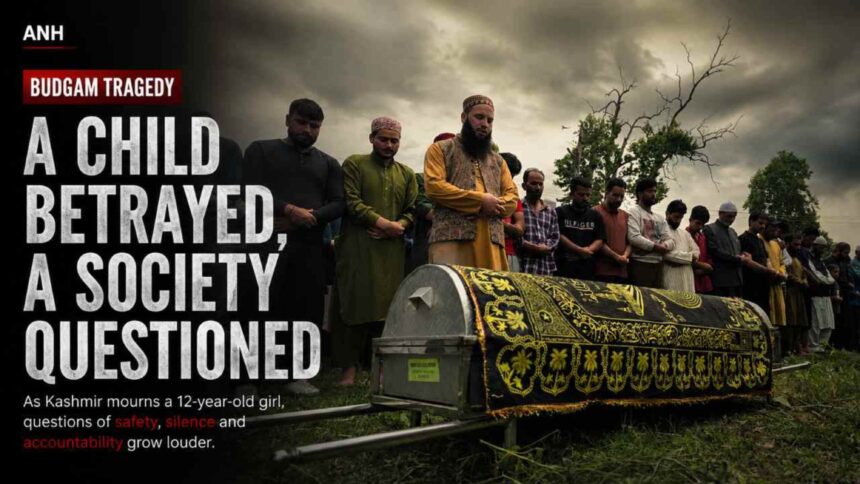
Srinagar, May 25: The alleged rape and killing of a 12-year-old girl in Budgam has left Kashmir heartbroken. A child left her home on a Saturday afternoon for a religious class. Like countless children across the Valley, she stepped out with the expectation that she would return home a few hours later. Instead, by Sunday morning, her body was found just a short distance from her home. Police have constituted a Special Investigation Team, and the law must now take its course. Those responsible must be identified and punished.
But while investigators work to establish the facts, society cannot escape a painful question: what does it say about us that a child going to a madrasa was not safe?
This is not merely a criminal case. It is a moment of reckoning. It is a tragedy that forces Kashmir to look beyond the immediate horror and ask difficult questions about the society we have become.
For years, public discussions about women and girls have often revolved around clothing, modesty and behaviour. Open social media on any given day and there will be people ready to lecture women about how they should dress, where they should go, and how they should conduct themselves. There is never a shortage of advice for women. There is never a shortage of judgment directed at girls.


Yet today, all those arguments stand shattered.
The victim was a twelve-year-old child. According to local accounts, she was on her way to a madrasa. Residents said she was carrying a Quran. She was reportedly dressed in accordance with every social and religious expectation that society claims to value and protect.
ALSO READ: DGP, IGP Kashmir, top officials reach Gulmarg after 300 tourists stranded in Gandola


If even such a child was not safe, then who is?
That question should echo across every home, every mosque, every school and every social media platform in Kashmir.
Because the reality exposed by this tragedy is that the problem was never women’s clothing. The problem was never whether girls were modest enough. The problem was never whether women stayed within certain social boundaries.
The problem lies elsewhere.
The problem lies with those men who harass, abuse and commit violence against women and children. The problem lies in attitudes that continue to excuse, minimize or ignore behaviour that makes women feel unsafe. The problem lies in a society that often finds it easier to question women than to hold men accountable.
For years, women across Kashmir have spoken about harassment in buses, markets, schools, workplaces and public spaces. Many have stories of being followed, stared at, verbally abused or made to feel uncomfortable. These incidents may not always make headlines, but they are part of a reality that women experience every day.



Too often, these concerns are dismissed.
Too often, women are told they are exaggerating.
Too often, the conversation shifts from the actions of men to the choices of women.
This tragedy should end that debate once and for all.
When a child going for religious education becomes a victim of such a crime, no one can honestly argue that clothing is the issue. No one can honestly claim that women would be safer if they dressed differently. No one can continue pretending that the burden of safety lies on girls and women.
The burden lies on society.
More specifically, it lies on the men of society.
Not every man is responsible for this crime. Not every man harasses women. The overwhelming majority of Kashmiri men are decent, compassionate and deeply disturbed by what has happened.
But it is still men who must take the lead in confronting the attitudes and behaviours that make women feel unsafe.
ALSO READ: CM Sends Deputy CM to Gulmarg to Monitor Rescue Efforts Following Gondola Disruption
It is men who must challenge friends when they make inappropriate remarks.
It is men who must teach young boys respect, empathy and accountability.
It is men who must stop remaining silent when they witness harassment.
It is men who must recognize that protecting women does not mean controlling them. It means creating an environment where they can live without fear.
ALSO READ: Citizens Seek Salary Hike for Middle-Class as Fuel Prices Continue to Rise
This is where some of the loudest voices in society must engage in self-reflection.
Social media is full of people who spend hours discussing women’s clothing and morality. They speak passionately about preserving culture and values. They criticize women for the smallest perceived deviation from social expectations.
Where are those voices today?
Will they acknowledge that the victim was a child reportedly on her way to a madrasa?
Will they admit that this tragedy has nothing to do with how women dress?
Will they finally accept that a society’s honour is not measured by how strictly women are controlled, but by how safely they can live?
Because if a girl dressed according to society’s expectations and heading for religious education was not safe, then the arguments used to blame women collapse entirely.
The truth is painful, but it must be said.
Kashmiri society has failed.
It has failed this child.
It has failed every woman who has quietly endured harassment.
It has failed every girl who has been told to limit her freedom for her own safety.
It has failed every parent who now looks at their daughter and wonders whether she is truly safe outside the home.
This does not mean Kashmir is uniquely flawed. Crimes against women occur across the world. But acknowledging that reality should not become an excuse to avoid introspection. A society that prides itself on its values must be willing to examine its shortcomings honestly.
Chief Minister Omar Abdullah was right when he described this tragedy as a moment of introspection. It should be exactly that.
ALSO READ: Body of Youth Retrieved from Jhelum After Six Days
Justice is essential. The investigation must be thorough, professional and transparent. The guilty must face the strongest punishment permitted under law.
But justice alone will not answer the larger question.
The larger question is whether society is willing to learn from this tragedy.
Will we continue blaming women and policing their choices?
Or will we finally confront the behaviours and attitudes that make women and children vulnerable?
Will we continue telling daughters to be careful?
Or will we start teaching sons to be responsible?
As Kashmir mourns this young girl, the conversation should not end with outrage. It should begin with honesty.
Somewhere tonight, a mother is grieving a daughter she expected to see again. Somewhere, a father is struggling to understand how a routine trip to a religious class ended in unimaginable loss. And across Kashmir, thousands of parents are asking themselves the same question:
If a twelve-year-old girl going to a madrasa was not safe, how can any parent feel completely assured that their own child is?
Until society can answer that question with confidence, this tragedy will remain not only a crime committed by an individual, but a painful reminder of a collective failure that can no longer be ignored.