Chandigarh, November 9: Air pollution has worsened across Punjab and Haryana following Diwali celebrations, with firecracker emissions, stubble burning and unfavourable weather conditions contributing to dangerously high pollution levels in several cities.
Read More: Three Killed, Over 40 Injured as Bus Plunges into Ditch on Agra-Lucknow Expressway
Air pollution experts said the combined impact of firecrackers and agricultural fires has pushed air quality to alarming levels, while a thick blanket of smog has covered residential areas in several towns and cities across the two states.
In Punjab, Mandi Gobindgarh emerged as one of the worst-affected cities, recording an Air Quality Index (AQI) of 445 on November 8, placing it in the ‘Severe’ category. Its AQI stood at 399 on November 9, according to reported Central Pollution Control Board (CPCB) data.
Other major cities in the state also reported elevated pollution levels. Ludhiana recorded an AQI of 313, followed by Jalandhar at 298, Amritsar at 234 and Patiala at 210.


The situation in Haryana remained concerning, with several cities reporting AQI readings above 300 after Diwali celebrations.
Bahadurgarh recorded an AQI of 389, while Rohtak stood at 379 and Bhiwani at 377. Charkhi Dadri and Sirsa both registered 363, while Gurugram reported an AQI of 316. These readings placed air quality in the ‘Very Poor’ category across several parts of the state.
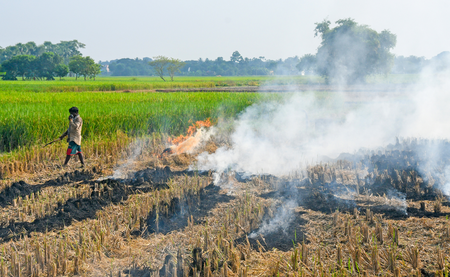
Experts have attributed the deterioration to firecracker emissions coinciding with the ongoing paddy stubble-burning season. Despite restrictions on firecrackers, celebrations reportedly continued beyond permitted hours in several areas, adding smoke and harmful particulate matter to the atmosphere.


Punjab has also witnessed a rise in farm fires. According to reported figures, 1,152 new stubble-burning incidents were recorded on November 8 alone, taking the seasonal total to 4,459.
Smoke from agricultural fields, combined with vehicular emissions, industrial pollution and construction dust, has further contributed to the worsening air quality.
The pollution crisis has raised public health concerns, particularly for children, senior citizens and people with asthma, heart conditions and other respiratory illnesses.
Health experts warn that prolonged exposure to polluted air can lead to coughing, breathing difficulties, throat irritation and eye allergies. Even otherwise healthy individuals may experience respiratory discomfort when pollution levels remain high.
Residents have been advised to limit outdoor activities, avoid morning walks in heavily polluted areas and wear well-fitted N95 masks whenever outdoor exposure cannot be avoided.
Experts have also stressed the need for stronger enforcement of firecracker restrictions, better agricultural residue management and stricter monitoring of industrial and vehicular emissions to address the recurring pollution problem.



With winter conditions approaching, falling temperatures and low wind speeds could further trap pollutants close to the ground, potentially prolonging the smog episode across Punjab and Haryana.
–IANS