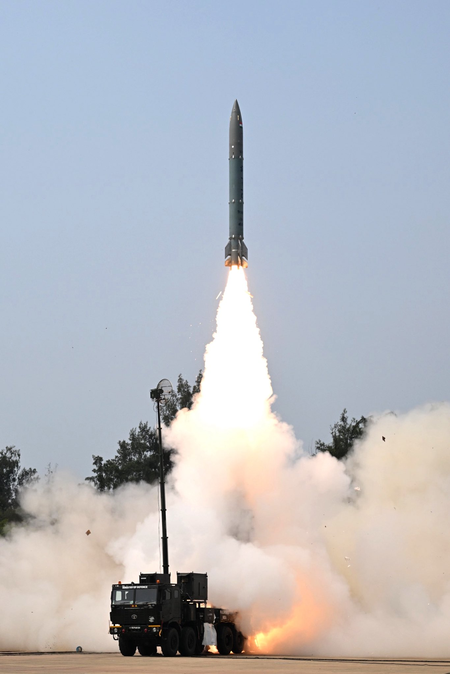
New Delhi, November 5: India has achieved another milestone in its indigenous defence programme, with the Defence Research and Development Organisation (DRDO) successfully conducting a flight test of its surface-to-surface Pralay missile off the Odisha coast on Thursday.
Defence Minister Rajnath Singh announced the successful Pralay missile test, stating that the trial was conducted at 11:10 am as part of user evaluation trials.
Read More: ‘Time to Give It to the Future’: Cristiano Ronaldo Announces International Retirement
“DRDO successfully conducted the flight test of the indigenously developed Pralay Missile off the coast of Odisha today at 1110 hrs,” Singh said in a post on X.
He added that the missile test fulfilled all its designated objectives, with the results confirmed through data recorded by various range instruments.



The Defence Minister described the successful trial as another important step towards strengthening India’s indigenous defence capabilities and reducing dependence on foreign defence technology.
Pralay Missile Trial Marks Progress in India’s Defence Programme
The Pralay missile is an indigenously developed surface-to-surface weapon system designed as part of India’s efforts to strengthen its domestic missile development capabilities. The latest flight trial was conducted to assess the system during its user evaluation phase.
The successful test adds to a series of recent achievements by DRDO in developing advanced defence technologies within the country.


DRDO’s High-Altitude Platform System Achieves 21 Km Altitude
Last month, DRDO also announced the successful flight trial of its indigenous High-Altitude Platform System (HAPS), demonstrating its ability to operate in the stratosphere at an altitude of up to 21 km.
Read More: J&K L-G chairs review meeting of Prison department
According to the Ministry of Defence, the experimental flight reached 21 km above mean sea level and maintained an altitude of around 20 km for more than 30 minutes before being directed to descend.
The platform was safely recovered after the trial, and the collected flight performance data was analysed to assess the system’s capabilities.
The Ministry said the trial demonstrated the platform’s ability to remain operational in the stratosphere, an environment that could support long-duration surveillance, communication and monitoring operations.
During the mission, the airborne platform continuously transmitted real-time video footage and vehicle performance information to the ground control station.



Officials said the system carried several instrumentation and control components, including an inertial measurement unit, GPS receiver, onboard cameras and altitude-control mechanisms. These systems functioned as intended throughout the flight.
Multiple Agencies Supported HAPS Flight Trial
The HAPS trial was conducted in coordination with several defence and civil aviation agencies, including the Indian Air Force, Centre for Military Airworthiness and Certification (CEMILAC), Directorate General of Civil Aviation (DGCA) and Airports Authority of India (AAI), along with other civil authorities.
The successful development and testing of indigenous systems such as Pralay and HAPS reflect India’s continuing efforts to expand domestic research, development and manufacturing in the defence sector.
–IANS