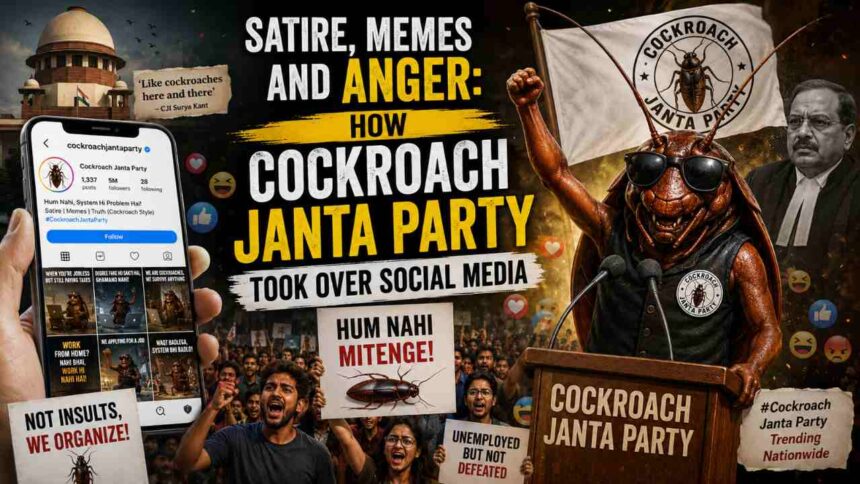
Srinagar, May 20: A satirical online movement calling itself the “Cockroach Janta Party” (CJP) has taken social media by storm, crossing ten million followers on Instagram within days of its launch on May 16, 2026. The page has quickly emerged as one of the country’s fastest-growing internet-led political satire platforms, fuelled by memes, reels, and growing frustration among young people.
ALSO READ: Unidentified Person Jumps Into Jhelum From Budshah Bridge, Rescue Ops Underway
The movement surfaced after controversial remarks made during a Supreme Court hearing by Chief Justice of India Surya Kant triggered widespread outrage online. The comments, which many users interpreted as insulting toward sections of India’s youth, sparked a flood of memes and sarcastic reactions across social media.
The controversy began during a hearing on a petition related to the designation of senior advocates. The bench, comprising Chief Justice Surya Kant and Justice D. Y. Chandrachud, was hearing arguments filed by advocate Sanjay Dubey when the Chief Justice made strong observations about what he described as increasing attacks on the judiciary and the presence of people with “fake” credentials in respected professions.
Soon after clips and excerpts from the hearing circulated online, the phrase “Cockroach Janta Party” began trending and eventually evolved into a full-fledged internet movement.



The platform was started by Abhijeet Dipke, an Indian who has been living in the United States for the past two years. What began as an online joke quickly evolved into a larger youth-driven space where thousands of young Indians started expressing frustration over unemployment, uncertainty, and political disillusionment.
Speaking during an online interaction, Dipke said the idea emerged directly from the public reaction to the remarks.
“Honestly, the credit probably goes to the Chief Justice himself. Had that comment not happened, I don’t think this movement would have existed,” he said.



Explaining the unusual name, Dipke said many young people already feel ignored or looked down upon in public discourse.
“The word ‘cockroach’ reflects how many unemployed youth feel they are treated — as lazy, useless, or unwanted,” he said.
According to him, the platform is meant for people who believe neither the government nor the opposition is genuinely addressing their concerns.
“This is for people who feel invisible. Nobody talks about what young people are actually going through,” he said, adding that Gen Z users are driving the movement online.
The page has exploded with parody posters, sarcastic campaign slogans, political satire, and humorous “membership criteria.” One viral line jokingly described eligibility for joining as: “Must be unemployed, chronically online, lazy, and capable of ranting professionally.”
Dipke admitted he never expected the response to become so massive.
“If this had been carefully planned, it probably would not have worked. The response keeps growing every hour,” he said.



At the same time, the movement’s sudden popularity has also triggered scepticism. Critics online have questioned whether the platform is merely channelling public anger into memes and internet humour instead of meaningful political action. Others have pointed to Dipke’s past association with the Aam Aadmi Party, suggesting the movement could eventually take a political shape.
The phenomenon has also found resonance among young people in Kashmir, where unemployment and uncertainty remain major concerns.
A university student from Srinagar said the movement reflected the frustration many young people silently carry.
“I think people connect with it because most of us are struggling in one way or another. The humour makes it relatable,” the student said.
Another student, however, cautioned against blindly embracing internet-led movements.
“Social media can turn anything viral overnight. But people also need to stay careful because emotional reactions online are often used later for political purposes,” he said.
For now, the “Cockroach Janta Party” remains more of a digital satire movement than a formal political organisation. Yet its rapid rise underlines how memes, humour, and online culture are increasingly becoming tools of political expression for India’s younger generation.
Following the backlash, Chief Justice Surya Kant later clarified that his remarks had been selectively interpreted. He said his criticism was directed only at individuals using fake or bogus degrees to enter professions such as law and media, and not at the youth of the country in general.
ALSO READ: Modi, Shah Traitors, Who Sold Hindustan: Rahul At Rally In Raebareli
He maintained that it was completely wrong to portray his observations as an attack on young Indians, insisting that his comments were aimed specifically at fraudulent individuals who, according to him, had infiltrated