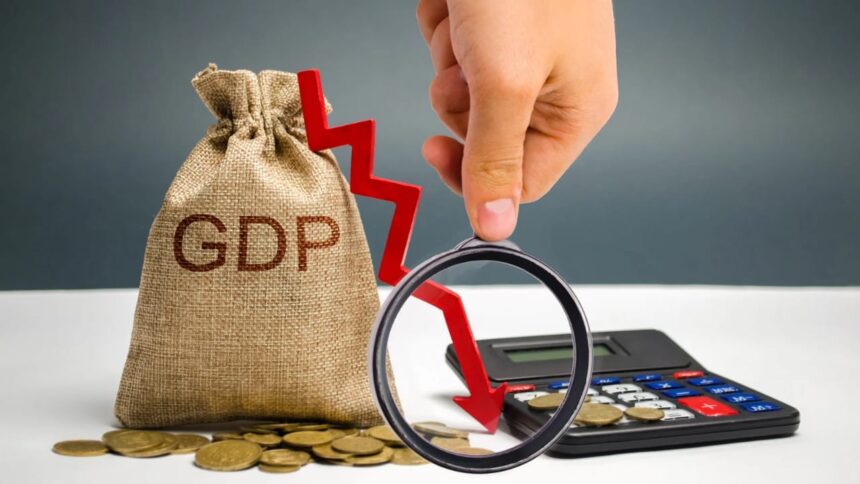
New Delhi, Apr 17: In the latest International Monetary Fund (IMF) rankings released in April 2026, India has been placed in sixth position, even as it retained its position as the fastest-growing major economy.
As per the IMF’s April 2026 WEO estimated India’s nominal GDP at USD 4.15 trillion, placing it behind the United Kingdom (USD 4.26 trillion) and Japan (USD 4.38 trillion).
The United States remained the world’s largest economy at USD 32.38 trillion, followed by China at USD 20.85 trillion and Germany at USD 5.45 trillion.
India had earlier been ranked as the fourth-largest economy, but has now been overtaken by both the UK and Japan in nominal GDP terms.
France (USD 3.6 trillion), Italy (USD 2.74 trillion), Russia (USD 2.66 trillion) and Brazil (USD 2.64 trillion) followed India in the global rankings, the IMF data showed.



The IMF said the Indian economy is projected to grow at 6.5% in 2026, making it the fastest-growing major economy, with growth expected to remain at the same level in 2027.
“For 2026, growth is revised upward moderately by 0.3 percentage point… to 6.5%, led by positive contributions from the carryover of the strong 2025 outturn and the decline in additional US tariffs on Indian goods,” the IMF said.
The Fund noted that easing tariff pressures and momentum from strong domestic performance have supported the outlook, outweighing adverse effects from escalating tensions in West Asia.



ALSO READ: Rapid conversion of paddy fields raises food security concerns in Kashmir
Globally, the IMF projected growth to slow to 3.1% in 2026 and 3.2% in 2027, down from 3.4% in 2025, as geopolitical tensions, particularly the conflict in the Middle East, weigh on economic activity.
The report warned that the global economy faces renewed risks from the conflict, including disruptions to commodity markets, rising inflation expectations and tighter financial conditions.
Assuming the war is relatively short-lived, global growth is expected to slow modestly, the IMF said.
It also flagged rising trade tensions, fiscal pressures and financial market volatility as key downside risks, particularly for emerging markets and developing economies.
ALSO READ: Boy thrown into burning tandoor for eating rasgullas at wedding



The relatively modest downward revision to global growth in the reference forecast relative to the January 2026 WEO Update owes to continued tailwinds partially offsetting the negative shocks from the conflict, including lower tariffs, preexisting policy support, and carryover from stronger-than-expected outturns at the end of 2025 and the first quarter of 2026 in some cases.